top of page

NEW: 2026 First Edition NALS Emergency Manual
Product Details
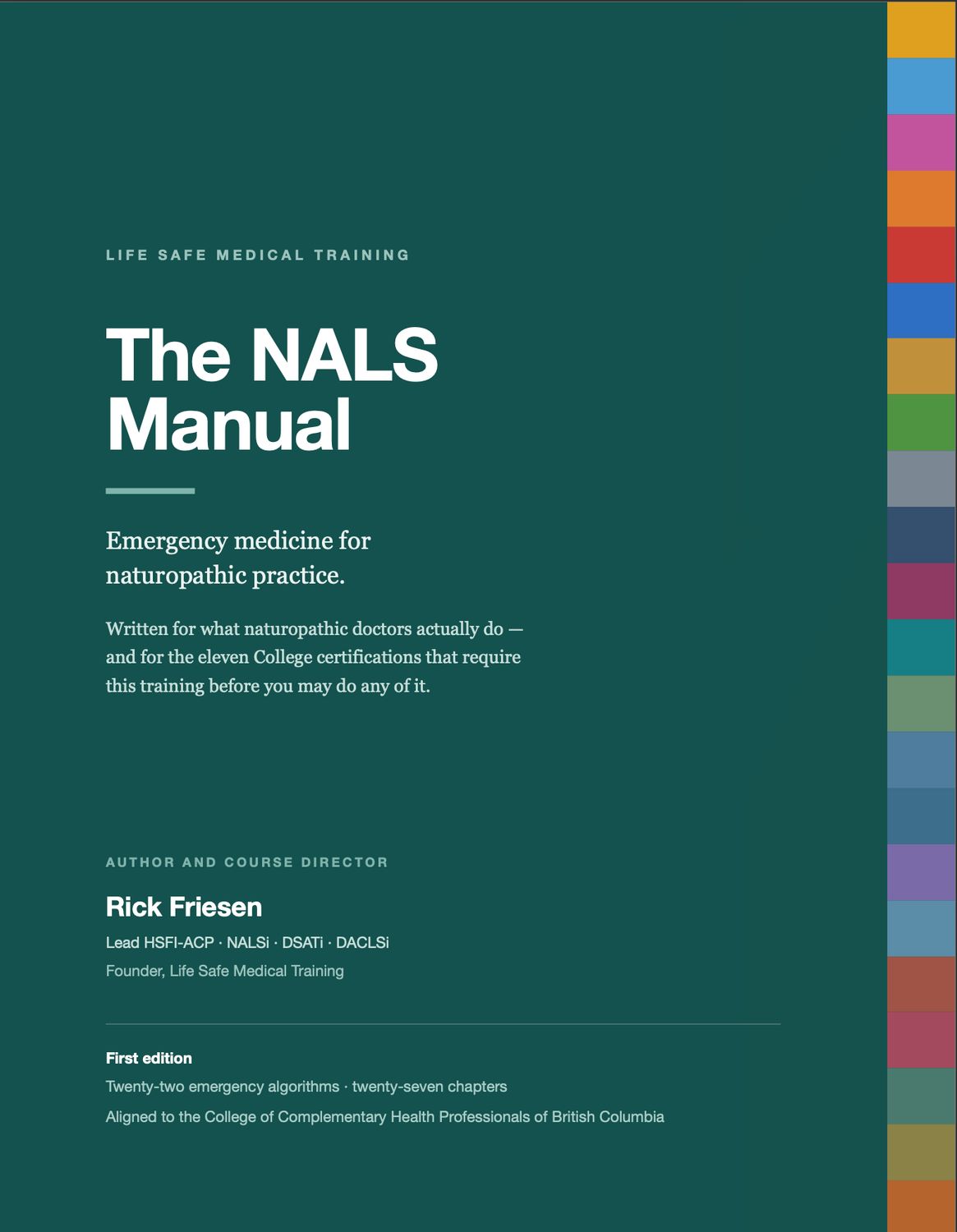
The NALS Manual
Emergency medicine for naturopathic practice
Resuscitation is taught almost entirely from the hospital. Nearly every emergency course an ND has taken assumes a crash team, a monitor, a pharmacy, and a colleague who can give the drugs while you run the code. You have none of those. You have a small room, one or two staff who are not clinicians, a kit you assembled yourself, and an ambulance four to twenty minutes away.
That is not a limitation to apologise for. It is the working environment of naturopathic medicine, and it changes what good emergency care looks like. This manual is built for that room.
What makes it different
Most emergency material for NDs is repurposed from dental sedation or hospital ACLS. This is written from the ground up for naturopathic scope, and it takes seriously the fact that the emergencies you are most likely to manage are emergencies your own procedures caused — an infusion reaction, a vasovagal at needle insertion, hypocalcaemia during chelation, local anaesthetic toxicity during prolotherapy, vascular occlusion after filler, a pneumothorax after thoracic needling.
Part III is organised by CCHPBC certification schedule, so an ND certified in IV and ozone therapy reads the chapters covering IV and ozone therapy. No other emergency text is arranged this way.
Every step is marked for the authority it requires
Four tiers run through the whole book: unmarked steps that every ND may perform regardless of certification; steps requiring Prescriptive Authority; steps requiring Prescriptive Authority and IV certification; and care that is out of scope, included only so you recognise it and know how urgently to move. You read your own scope off the page instead of guessing at it during an emergency.
Inside
- Part I — The method. The systematic approach, your team and the no-delegation rule, the emergency kit, oxygen and airway, monitoring, calling for help and handover, and debriefing.
- Part II — Core medical emergencies. Anaphylaxis, asthma, severe bleeding, brady- and tachycardia, cardiac chest pain, cardiac arrest, shock, hypoglycaemia, seizure, stroke.
- Part III — Procedure emergencies. Infusion reactions, vasovagal syncope, vascular access complications, injection and aesthetic emergencies, acupuncture, immunization and choking — arranged by the certification that gives rise to them.
- Part IV — Scope across Canada. British Columbia as the reference standard, with provincial variance.
- Part V — Emergency drug formulary. Indication, dose, route, contraindications and required authority for every drug in the kit.
- Part VI — Apparatus. Kit checklists, an incident record, a clinic preparedness audit, and a scenario bank for rehearsal.
NALS (1 Day) Nanaimo
C$450.00
bottom of page